Search Results
Artist Collective
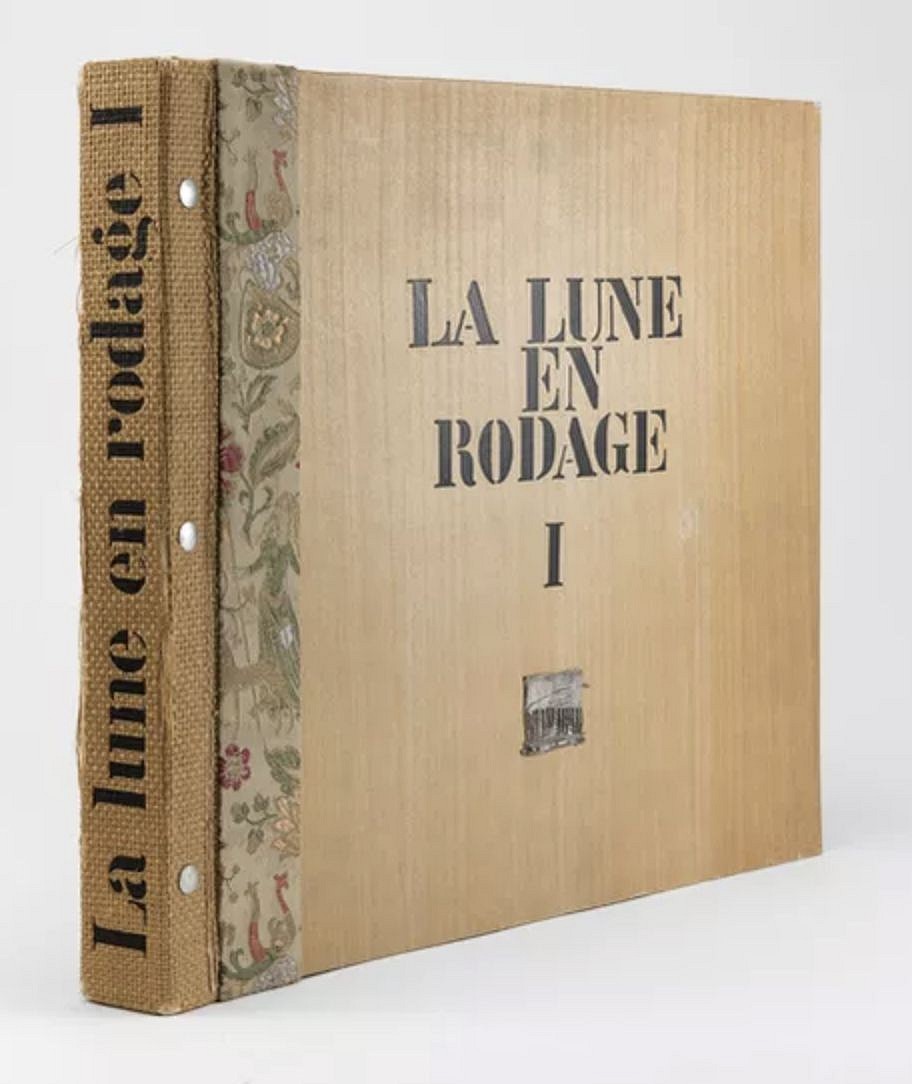
La Lune En Rodage *complete set, 1961
13346-BK
12 5/8 x 12 3/4 in. (32.3 x 32.4 cm)
Basel. Editions Panderma. 1961, 1965 & 1977.
3 volumes. Each volume bound in original hessian-backed printed imitation wood veneer, fastened with metal bolts. Each volume with a small bas-relief mounted on upper cover (Vol.1 - metal relief by Gio Pomodoro, vol.2 - plexi relief by Talman, vol. 3 - relief by Getulio Alviani).
The complete three-volume set of one of the most ambitious and important contemporary art portfolios of the post-war era. The volumes contain a combination of original and editioned works, and bring together many of the most cutting-edge avant-garde artists of the age, giving them the opportunity to work in mediums that in many cases they had not previously. The variety of original artwork ranges from drawings, gouaches, and collages, to graphics, photographs, sheets of letterpress text, music etc., with each work tipped onto thick card leaves of varying colors. The majority of the works are individually signed.
Artworks of note in the collection are Piero Manzoni's only editioned multiple (a cork print), a unique ‘concetto spaziale’ punched drawing by Lucio Fontana, Enrico Catellani's first multiple, a watercolor collage by Hundertwasser, a unique smoke drawing by Otto Piene, a unique torn collage by Jacques Villeglé, and other pieces by Arman, Jean Arp, Man Ray, Dieter Roth, and Victor Vasarely.
Each volume was published in an edition of 215 copies. Complete intact sets of La Lune en Rodage rarely appear, primarily because, just by their nature, the majority of copies have already been broken up for their constituent parts.
Volume 1: with 42 graphic works including engravings, gouaches, collages, drawings and photographs, including the original watercolour collage signed by Hundertwasser, 1 original signed painting in mixed media (gouache, pastel and charcoal) by Antonio Lino, one unique drawing by Lucio Fontana, dated and signed. Most of the other works are signed by the artists: Yoran Cazac, Bazon Brock, Carlo Belloli, Benjamin Péret, Toyen, Raymond Hains, Sigismond Kolos-Vary, Victor Vasarély, Piero Heliczer, Peter Vogel, Markus Prachensky, Herbert Schuldt, Humbert, Pierre Gripari, Hammarberg, Enrico Castellani, Hansjorg Mattmüller, Guerdon, Man Ray, Roberto Crippa, Eugène Ionesco, Francois Béalu, Onorio, P.A. Benoit, Meret Oppenheim, Renate Axt, Carl Laszlo, Lora, Bill von Bredow, Christianna Thias, Otto Piene, Rolf Fenkart, Heinz Mack, Esther Wirz, Bischof, Chr. Schmidt, Bischoffshausen, Enrico Baj, Herchenröder, Brauer, Hans Platschek, Rippstein, Franz Fedier, Arman, Nico Taratès, Fat Charrière, Milet, Jean Cocteau, Lucien Clergue, Arnulf Rainer, Childs, Wolfgang Hollegha, Josef Mikl, Nina Mayo, Peter Brüning, Bruno Munari, Jean Arp, Michel Cardenas, Rene Mächler, and Camille Bryen;
Volume 2: with 56 graphic works including etchings, gouaches, watercolors, collages and drawings, including 1 original collage signed by Walter Leblanc, 1 original collage signed by Hermann Goepfert, and 1 original drawing signed by Dieter Roth. Most of the works are again signed by the artists, who include Victor Vasarély, Hundertwasser, Friedrich Schröder Sonnenstern, Sigurd Kuschnerus, Walter Leblanc, Giuseppe Capogrossi, Edmondo Bacci, Genevieve Claisse, Hermann Goepfert, Christian Megert, Lucio del Pezzo, Zoltan Kemény, Hsiao Chin, Liliane Lijn, Dieter Roth, Giovanni Macciotta, Paul Wunderlich, Francois Dufrêne, Carl Reuterswaerd, Francisco Sobrino, Gianni Bertini, Thomas Bayrle, Hans Peter Alvermann, Gunther Uecker, Jacques Villeglé, Francois Morellet, Kassák, Lajos Weber, Rene Bertholo, Kaspar Thomas Lenk, Eduardo Alcoy, Alberto Biasi, Arnold Leissler, Piero Dorazio, Jean-Pierre Yvaral, and Carlo Belloli.
Volume 3: with 54 graphic works, most signed by the artists - includes works by Timm Ulrichs, Marcello Morandini, Erich Buchholz, Willy Müller-Brittnau, Floris Michael Neusüss, Thomas Ring, Christian Schad, Yves Laloy, Augustin Tschinkel, Imre Kocsis, Markus Raetz, Lajos Kassák, Getulio Alviani, Enzo Cacciola, Thilo Maatsch, Otto Nebel, Peter Stämpfli, Fifo, Edmund Kesting, Gianni Colombo, Jorrit Tornquist, Walter Dexel, Lou Loeber and Michael Ashur.
Price Upon Request
Dieter Roth Essays
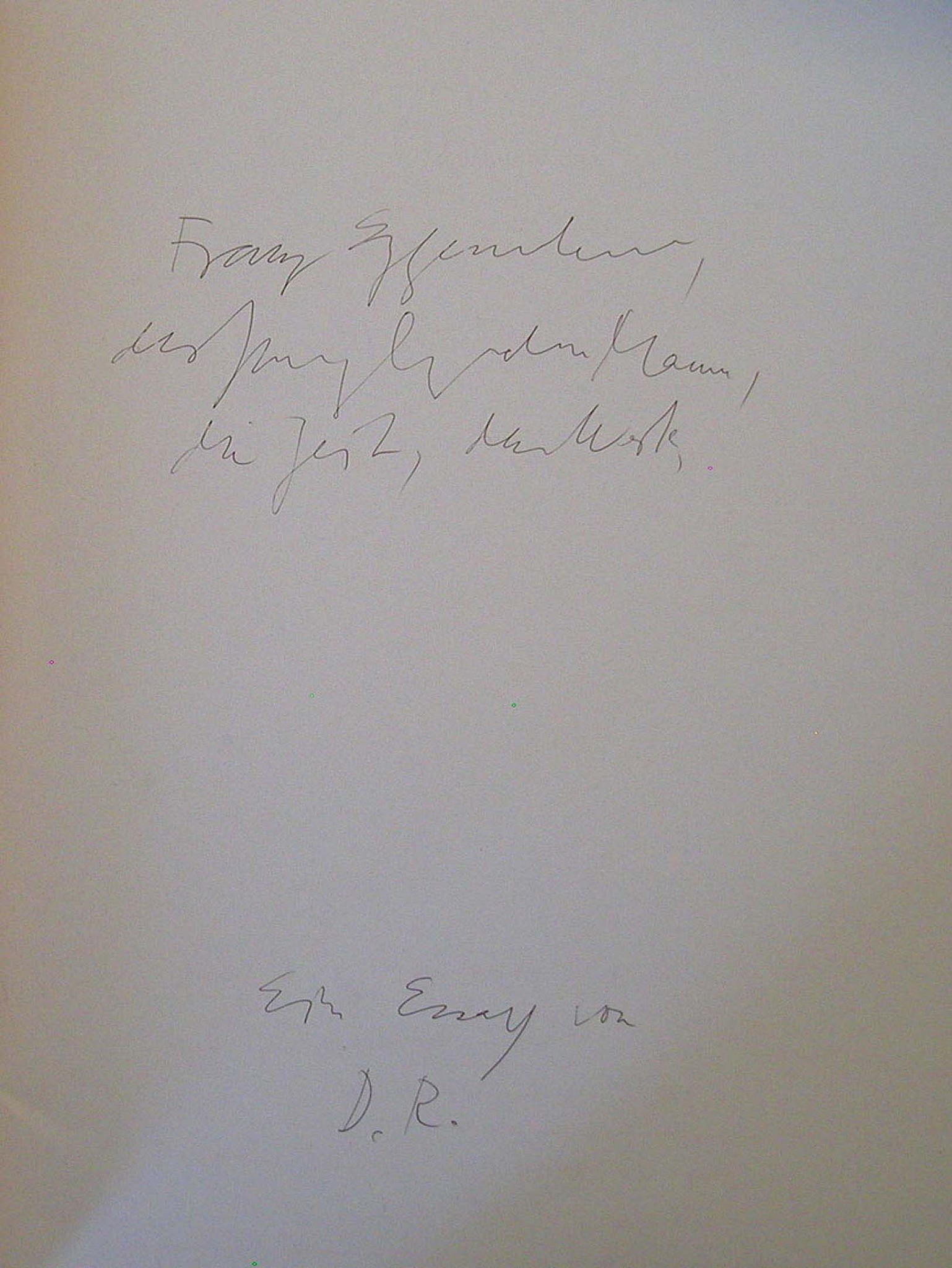
Franz Eggenschwiler: der Jungling, der Mann, die Zeit, das Werk. ( franz eggenschwiler the young man the man his time his work (until today 2 5 71}), 1971
1393
11 3/4 x 8 1/4 in. (29.7 x 21 cm)
64 pages original rotaprints. 29,6 x 21 cm stapled. Printed by R. May Dusseldorf. Published by edition Hansjorg Mayer Stuttgart. 400 copies. Thereof 130 numbered and signed as introduction to a portfolio of prints by Franz Eggenschwiler.tHIS COPY IN NOT NUMBERED OR SIGNED because is coming from the printer. DR. CW. 20 # 48.
Price Upon Request
Carl Franz Anton Schreibers
Beyträge zur Geschichte und Kenntniss meteorischer Stein- und Metal-Massen, und der Erscheinungen, welche deren Niederfallen zu begleiten pflegen., 1820
3050-BK
15 5/8 x 11 in. (40 x 28 cm)
Price Upon Request
Carl Franz Anton Schreibers
Beyträge zur Geschichte und Kenntniss meteorischer Stein- und Metal-Massen, und der Erscheinungen, welche deren Niederfallen zu begleiten pflegen., 1820
3050-BK
(40 x 28 cm)
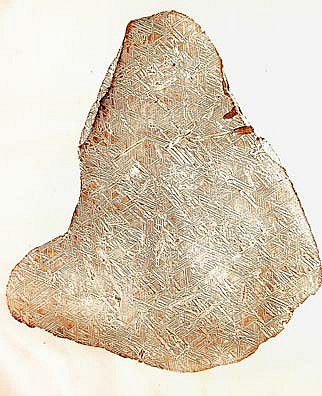
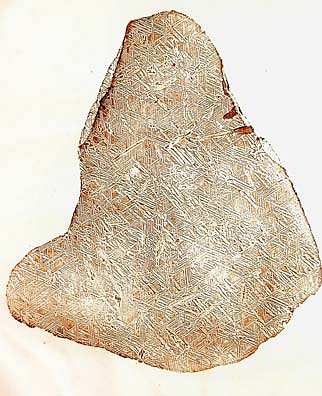
Vienna: Verlage von F. G. Heubner, 1820. First edition of the earliest iconography of meteorites with eight lithographed plates (one folding and another partly hand-colored), an engraved strewn field map, perhaps the first ever such map, showing not only the location of all of the 63 fragments, but the names of the villagers who collected them, including one remarkable plate—an impression taken directly from a meteorite that fell in about 1400, the first use of a mineral in nature printing. The Elbogen meteorite (as it is known, Elbogen being the German name for the village of Loket, today in the Czech Republic) is an exciting exception, being quite large (about 236 lb./170 kg). Fortunately, be it due to local superstition or awe, the stone was preserved. Pieces of it were distributed to museums around the world for scientific study. The biggest segment is deposited in the Naturhistorisches Museum in Vienna, weighing roughly 80 kilograms (180 lb.). It is there that the Austrian mineralogist, Count Alois von Beck Widmanstätten, encountered the rock. Intrigued, in 1808, he discovered that a sliced iron-rich meteorite could be etched with acid to reveal a distinct pattern (now known as the Widmanstätten pattern). This pattern could be recorded on paper by inking and printing directly from the etched meteorite surface. This book is the first ever to describe a particular meteorite collection. It has some of the most arresting images anywhere of recorded meteorites, including the double- page plate that opens the book, displaying the 86-pound chunk of iron that fell in Hraschina (Hrašćina), Croatia, on May 26, 1751. The images in the book were printed by lithography, which was invented around 1800; it may indeed be the first geology book anywhere to be illustrated with lithographs. And it revealed that when an iron meteorite is heated in a flame, or rinsed with acid, it reveals a distinctive pattern, known as a Widmanstätten pattern, that only appears on meteorites. Alois Widmanstätten had discovered this some years earlier (and was not in fact the first to do so), but most geologists learned about Widmanstätten patterns from a plate in von Schreibers’ book that was actually printed directly from an etched meteorite. Karl Franz Anton Ritter von Schreibers, an Austrian naturalist, was born Aug. 15, 1775. Although trained as a physician, von Schreibers took all of nature as his province, which made him the ideal choice to assume the directorship of the Vienna Natural History Museum in 1806. Although he was competent as a zoologist and botanist, his true love was minerals, and especially meteorites. The Vienna museum had been collecting meteorites since the 1740s, but it wasn't until the turn of the 19th century that scientists were finally convinced that meteorites were not some sort of atmospheric debris, but came to earth from deep space. Ref: Fischer No. 22, and Dr. William B. Ashworth, Jr., Consultant for the History of Science, Linda Hall Library and Associate Professor, Department of History, University of Missouri-Kansas City.
Price Upon Request
Vienna: Verlage von F. G. Heubner, 1820. First edition of the earliest iconography of meteorites with eight lithographed plates (one folding and another partly hand-colored), an engraved strewn field map, perhaps the first ever such map, showing not only the location of all of the 63 fragments, but the names of the villagers who collected them, including one remarkable plate—an impression taken directly from a meteorite that fell in about 1400, the first use of a mineral in nature printing.
The Elbogen meteorite (as it is known, Elbogen being the German name for the village of Loket, today in the Czech Republic) is an exciting exception, being quite large (about 236 lb./170 kg). Fortunately, be it due to local superstition or awe, the stone was preserved. Pieces of it were distributed to museums around the world for scientific study. The biggest segment is deposited in the Naturhistorisches Museum in Vienna, weighing roughly 80 kilograms (180 lb.). It is there that the Austrian mineralogist, Count Alois von Beck Widmanstätten, encountered the rock. Intrigued, in 1808, he discovered that a sliced iron-rich meteorite could be etched with acid to reveal a distinct pattern (now known as the Widmanstätten pattern). This pattern could be recorded on paper by inking and printing directly from the etched meteorite surface.
This book is the first ever to describe a particular meteorite collection. It has some of the most arresting images anywhere of recorded meteorites, including the double- page plate that opens the book, displaying the 86-pound chunk of iron that fell in Hraschina (HrašÄ‡ina), Croatia, on May 26, 1751. The images in the book were printed by lithography, which was invented around 1800; it may indeed be the first geology book anywhere to be illustrated with lithographs. And it revealed that when an iron meteorite is heated in a flame, or rinsed with acid, it reveals a distinctive pattern, known as a Widmanstätten pattern, that only appears on meteorites.
Alois Widmanstätten had discovered this some years earlier (and was not in fact the first to do so), but most geologists learned about Widmanstätten patterns from a plate in von Schreibers’ book that was actually printed directly from an etched meteorite.
Karl Franz Anton Ritter von Schreibers, an Austrian naturalist, was born Aug. 15, 1775. Although trained as a physician, von Schreibers took all of nature as his province, which made him the ideal choice to assume the directorship of the Vienna Natural History Museum in 1806. Although he was competent as a zoologist and botanist, his true love was minerals, and especially meteorites. The Vienna museum had been collecting meteorites since the 1740s, but it wasn't until the turn of the 19th century that scientists were finally convinced that meteorites were not some sort of atmospheric debris, but came to earth from deep space.
Ref: Fischer No. 22, and Dr. William B. Ashworth, Jr., Consultant for the History of Science, Linda Hall Library and Associate Professor, Department of History, University of Missouri-Kansas City.